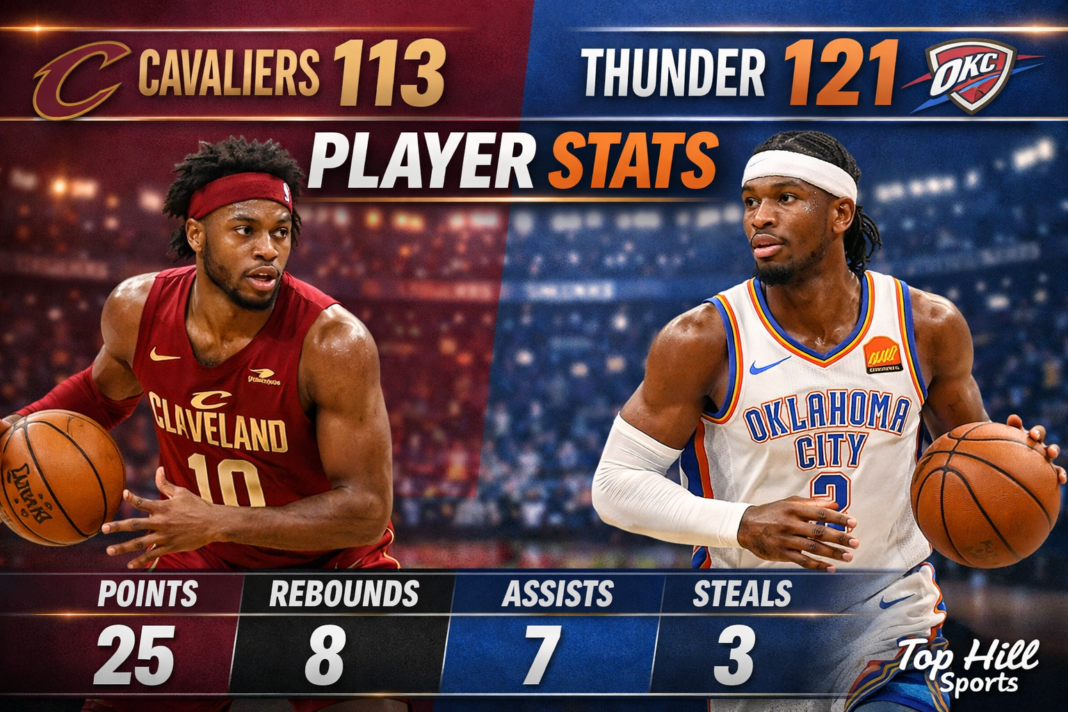
Final Score: Oklahoma City Thunder 121, Cleveland Cavaliers 113 | Paycom Center, Oklahoma City | February 22, 2026
The Cleveland Cavaliers vs OKC Thunder match player stats from February 22, 2026 tell a story of a shorthanded Thunder team that refused to blink. Isaiah Joe dropped 22 points, Cason Wallace put up a career-best 20 points and 10 assists, and Chet Holmgren controlled the glass with 17 points and 15 rebounds as Oklahoma City snapped Cleveland’s seven-game winning streak with a 121-113 win at Paycom Center. For the Cavs, Donovan Mitchell, James Harden, and Sam Merrill each chipped in 20 points, but a brutal 51.2% three-point shooting performance by OKC proved impossible to match.
Table of Contents
Quick Look: Final Score and Quarter Breakdown
Quarter | Cleveland Cavaliers | OKC Thunder |
|---|---|---|
Q1 | 25 | 40 |
Q2 | 30 | 24 |
Q3 | 31 | 25 |
Q4 | 27 | 32 |
Final | 113 | 121 |
OKC built a monstrous 15-point lead in the first quarter alone. Cleveland fought back to tie it at 86 midway through the third, but the Thunder answered every run down the stretch and never let go in the fourth.
Full Box Score: OKC Thunder Player Stats
Player | POS | PTS | REB | AST | STL | BLK | FG | 3PT | FT | +/- |
|---|---|---|---|---|---|---|---|---|---|---|
Isaiah Joe | G | 22 | 2 | 3 | 5 | 0 | 6-13 | 6-11 | 4-4 | +14 |
Cason Wallace | G | 20 | 4 | 10 | 3 | 0 | 7-17 | 4-8 | 2-2 | — |
Chet Holmgren | F | 17 | 15 | 4 | 1 | 3 | 5-14 | 1-4 | 6-9 | +17 |
Isaiah Hartenstein | C | 13 | 7 | 4 | 0 | 0 | 6-6 | 0-0 | 1-4 | +23 |
Luguentz Dort | F | 12 | 3 | 2 | 2 | 0 | 5-11 | 2-6 | 0-2 | +1 |
Jared McCain | G | 10 | 3 | 1 | 1 | 0 | 3-7 | 2-3 | 2-2 | -2 |
Jaylin Williams | F | 10 | 3 | 0 | 0 | 1 | 3-6 | 3-5 | 1-2 | -17 |
Kenrich Williams | G-F | 8 | 2 | 1 | 0 | 0 | 3-3 | 2-2 | 0-0 | -4 |
Aaron Wiggins | G | 7 | 3 | 4 | 0 | 0 | 3-7 | 1-2 | 0-0 | -2 |
Missing starters: Shai Gilgeous-Alexander (abdominal strain), Jalen Williams (strained right hamstring), Ajay Mitchell (abdominal strain), Alex Caruso (sprained left ankle)
Full Box Score: Cleveland Cavaliers Player Stats
Player | POS | PTS | REB | AST | STL | BLK | FG | 3PT | FT | +/- |
|---|---|---|---|---|---|---|---|---|---|---|
Donovan Mitchell | G | 20 | 7 | 5 | 2 | 0 | 9-19 | 0-6 | 2-3 | -1 |
James Harden | G | 20 | 5 | 9 | 1 | 1 | 8-14 | 3-7 | 1-2 | -13 |
Sam Merrill | G | 20 | 3 | 0 | 0 | 0 | 7-12 | 6-10 | 0-0 | +6 |
Evan Mobley | F | 15 | 2 | 1 | 1 | 0 | 6-11 | 1-4 | 2-2 | -3 |
Dennis Schroder | G | 11 | 4 | 7 | 1 | 1 | 3-9 | 1-2 | 4-4 | -3 |
Keon Ellis | G | 9 | 1 | 3 | 2 | 0 | 4-7 | 1-4 | 0-0 | 0 |
Jaylon Tyson | G-F | 7 | 4 | 0 | 1 | 0 | 2-7 | 1-4 | 2-2 | -1 |
Jared McCain | G | 10 | 3 | 1 | 1 | 0 | 3-7 | 2-3 | 2-2 | — |
Dean Wade | F | 0 | 3 | 1 | 0 | 1 | 0-1 | 0-1 | 0-0 | -13 |
Nae’Qwan Tomlin | F | 0 | 2 | 0 | 0 | 0 | 0-3 | 0-1 | 0-0 | +3 |
Team Stats: Head-to-Head Comparison
Stat | Cleveland Cavaliers | OKC Thunder |
|---|---|---|
Points | 113 | 121 |
Field Goals | 43-89 (48.3%) | 42-86 (48.8%) |
Three-Pointers | 13-39 (33.3%) | 21-41 (51.2%) |
Free Throws | 14-19 (73.7%) | 16-25 (64.0%) |
Total Rebounds | 54 | 50 |
Offensive Rebounds | 12 | 13 |
Assists | 28 | 32 |
Steals | 9 | 12 |
Blocks | 3 | 4 |
Turnovers | 17 | 16 |
Points Off Turnovers | 12 | 31 |
Points in Paint | 56 | 40 |
Fast Break Points | 21 | 17 |
Second Chance Points | 8 | 17 |
Bench Points | 47 | 37 |
Biggest Lead | 1 | 23 |
Advanced Stats Snapshot
Metric | Cleveland | OKC |
|---|---|---|
Offensive Rating | 110.4 | 121.0 |
Defensive Rating | 110.4 | 121.0 |
Effective FG% | 55.6% | 61.0% |
True Shooting% | 58.0% | 62.4% |
Assists/Turnover Ratio | 1.65 | 2.0 |
Points Per Possession | 1.10 | 1.21 |
Possessions | 102.4 | 100.0 |
What Actually Happened in This Game
Here is the thing about this matchup: nobody expected the Thunder to run Cleveland out of the building while missing four key players.
OKC came into this one without Shai Gilgeous-Alexander, Jalen Williams, Ajay Mitchell, and Alex Caruso. That is roughly the top three or four rotation players on one of the best teams in the NBA. Cleveland had won seven straight. The Cavs were hot. The Cavs were healthy. On paper, this looked like a gift.
And then the first quarter happened.
Oklahoma City jumped out to a massive early advantage, and Cleveland found itself chasing the game from the opening tip. The Thunder scored 40 points in the first quarter alone, building a lead that would reach as high as 23 points.
The comeback was real, though. Cleveland did not just roll over. Merrill heated up in the third quarter, the Cavs clawed all the way back, and Cleveland tied the score at 86 heading into the final stretch. For a moment, it genuinely looked like the Cavs were going to pull off the comeback.
Then OKC’s fourth-quarter execution took over.
Three consecutive triples from Luguentz Dort, Kenrich Williams, and Cason Wallace pushed the Thunder ahead 102-95. Isaiah Hartenstein followed that up with back-to-back buckets inside to extend the lead to 106-98, a margin Oklahoma City never gave back.
Isaiah Joe: The Unexpected Hero of the Night
Nobody had Isaiah Joe circled on their fantasy lineups going into this one. And yet here we are.
Joe led the Thunder in scoring with 22 points on six three-pointers, while also putting together what might have been his best defensive performance of the season with five steals, all of which came in the first quarter.
His shooting line: 6-of-13 from the field, 6-of-11 from three. That is simply elite shooting from deep. The Thunder saw six different players connect on two or more triples in the game, with Joe leading the parade from beyond the arc.
When SGA is out, someone has to step up. On this particular Sunday, it was Joe, and his performance held up under pressure.
Cason Wallace: Career Night When It Mattered
This was a different Cason Wallace than the league had seen in recent weeks. Wallace closed the game with 20 points on 7-of-17 shooting, including 4-of-8 from three, adding four rebounds, 10 assists and three steals across 34 minutes. The points-assists double-double was a career first for the third-year guard.
For context on how big that was: through nine games in February heading into that performance, Wallace had been averaging just 12.8 points and 4.7 assists per game. This was a big step above his recent output.
Wallace was particularly important in the fourth quarter, running the pick-and-roll with Hartenstein to generate high-percentage looks at the rim while also drilling four triples on the night. His court vision and willingness to make the right pass at the right moment is what separates him from being a spot-up shooter to being an actual offensive engine for this team.
Chet Holmgren: Doing What He Always Does
Holmgren finished with 17 points, 15 rebounds, and three blocks. His stat line is clean, reliable, and does exactly what the Thunder need from him.
The double-double was his latest in what has become a consistent run of strong performances. His plus-minus of +17 led all OKC players on the night, meaning the Thunder outscored Cleveland by 17 points in his minutes. That is not a small detail.
What stands out in his line is the defensive rebounding: 13 defensive boards in a game where Cleveland was putting up 89 shot attempts. Holmgren made sure second looks were hard to come by.
Cleveland’s Three-Guard Scoring and Why It Still Was Not Enough
Donovan Mitchell, James Harden, and Sam Merrill all finished with exactly 20 points. That is a rare occurrence. Three players on the same team matching each other’s point totals in a loss is the kind of box score that makes you scratch your head.
Here is a quick look at how each of Cleveland’s top scorers got to 20:
Scorer | FG | 3PT | FT | Paint Points | Fast Break Pts |
|---|---|---|---|---|---|
Donovan Mitchell | 9-19 | 0-6 | 2-3 | 16 | 2 |
James Harden | 8-14 | 3-7 | 1-2 | 10 | 0 |
Sam Merrill | 7-12 | 6-10 | 0-0 | 0 | 5 |
Mitchell did most of his damage in the paint (16 of his 20 came there), but went 0-for-6 from three. Harden was efficient but turned it over five times. Merrill was the hot hand off the bench, hitting six triples, but his scoring came in bunches that the Thunder were able to absorb because OKC was always scoring back.
The real problem? Cleveland made just 13 of its 39 three-point attempts (33.3%), and despite mounting a serious comeback run, could not sustain the offense long enough to close out a team that was on fire from long range.
The Three-Point Gap Was the Difference
This is the most direct explanation for the final score, and it is not close.
Team | 3PT Made | 3PT Attempted | 3PT% |
|---|---|---|---|
OKC Thunder | 21 | 41 | 51.2% |
Cleveland Cavaliers | 13 | 39 | 33.3% |
OKC made eight more threes than Cleveland. At three points each, that is 24 extra points just from beyond the arc. That is more than the final margin. The Cavs’ entire 3-point performance deficit explains the loss.
The Thunder converted at 51.2% from deep, with six different players connecting on multiple triples. Two players, Joe and Jaylin Williams, only made three-pointers the entire night, and still contributed meaningfully.
That kind of team-wide shooting performance is nearly impossible to plan for or defend against. The Cavaliers did not shoot poorly by normal standards at 33.3%, but on this night they were going up against a historically hot three-point shooting performance.
The Injury Factor: OKC Without Its Best Players
Let’s be clear about the context here. The Thunder played this game without SGA (abdominal strain), Jalen Williams (strained right hamstring), Ajay Mitchell (abdominal strain), and Alex Caruso (sprained left ankle). That is four rotation players, including two All-Star caliber starters.
The inactive list for OKC also included Branden Carlson, Thomas Sorber, and others, meaning Oklahoma City was operating with a shorter rotation than usual.
And yet the Thunder went out and won by eight points, shooting 51.2% from three and controlling the game in the fourth quarter. That says something significant about the depth of this roster. When role players like Joe, Wallace, and Hartenstein can step up to that level on any given night, you understand why OKC entered this game at 44-14.
Points Off Turnovers: The Hidden Margin
One number that does not show up in a box score headline but matters enormously in explaining this result:
Team | Turnovers | Points Off Turnovers |
|---|---|---|
OKC Thunder | 16 | 31 |
Cleveland Cavaliers | 17 | 12 |
Cleveland had one more turnover than OKC, but the Thunder converted those turnovers into 31 points compared to Cleveland’s 12. That is a 19-point swing in points off turnovers alone. OKC was relentless in transition, turning every Cleveland mistake into easy buckets on the other end.
This is a core identity of the Thunder all season. They pressure the ball, create chaos, and run. When it is working like it did here, it is very difficult to overcome.
OKC’s Bench Produced in a Big Way
With the starting lineup heavily altered, the bench performance carries extra weight here.
OKC’s bench finished the game with 37 points, while Cleveland’s reserves put up 47. Cleveland technically won the bench battle. But that top-heavy production from OKC’s starters and the sheer volume of their three-point output made the bench edge irrelevant.
Hartenstein at center was a pivotal piece of this: 6-of-6 from the field, 13 points in just the fourth quarter alone, and that pick-and-roll with Wallace was basically unstoppable down the stretch.
Where Both Teams Stand After This Result
OKC Thunder (44-14): This win was their second over Cleveland this season. The record improvement to 44-14 keeps them firmly atop the Western Conference standings, and the depth they showed without their top players should make everyone in the league a little uncomfortable about the postseason.
Cleveland Cavaliers (36-22): The seven-game winning streak is done. Cleveland will move on to face the New York Knicks next, heading into a game where the Cavs hold a home record of 19-11. The loss hurts, but the Cavs remain a strong Eastern Conference team with real playoff aspirations. One bad shooting night from three does not change that.
Analysis: What This Game Tells Us About Both Teams
For OKC: The Thunder’s depth is genuinely elite. This was not a case of lucky shooting bailing out a mediocre performance. The ball moved (32 assists on 42 made field goals), the defense created turnovers and converted them at a high rate, and the fourth-quarter execution was crisp. This is a team built with real organizational depth, and it showed.
For Cleveland: The Cavs have a real identity built around interior scoring (56 points in the paint here) and disciplined half-court offense. But when they go cold from three, they do not have the defensive pressure to compensate. The 12 points off turnovers compared to OKC’s 31 is a structural problem they need to address heading into the postseason.
The three-point shooting variance is the biggest takeaway. A team shooting 51.2% from three versus one shooting 33.3% is almost always going to win, regardless of what else happens. The Cavs are not a bad three-point shooting team, they just ran into a historic performance on the wrong night.
For more coverage of NBA match player stats, game recaps, and team analysis throughout the 2025-26 season, visit TopHill Sports for in-depth breakdowns across the league.
A complete review of the Cleveland Cavaliers vs OKC Thunder match player stats from February 22, 2026 confirms one thing: OKC did not just survive without their stars, they thrived. Final score: Thunder 121, Cavaliers 113.