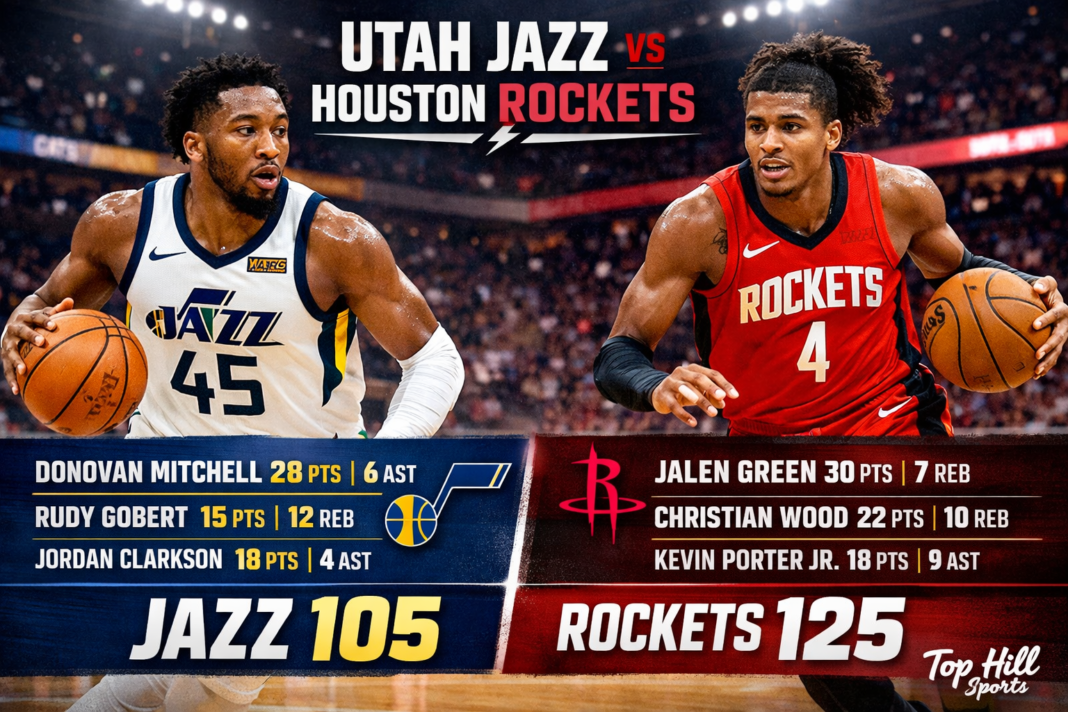
Feb 23, 2026 | Toyota Center, Houston, TX | Final Score: Houston Rockets 125, Utah Jazz 105
If you came here looking for the full Utah Jazz vs Houston Rockets match player stats from February 23, 2026 — you’re in the right place. Jabari Smith Jr. went off for 31 points on an absurd 70.6% shooting, Amen Thompson added 20, and the Rockets never let Utah breathe after a dominant first quarter. Houston won convincingly, 125-105, and the stats tell a story worth breaking down properly.
Table of Contents
Final Score and Quarter-by-Quarter Breakdown
Quarter | Houston Rockets | Utah Jazz |
|---|---|---|
Q1 | 38 | 22 |
Q2 | 30 | 25 |
Q3 | 32 | 28 |
Q4 | 25 | 30 |
Final | 125 | 105 |
Houston came out of the gate like a freight train. That 38-22 opening quarter set the tone for everything that followed. The Rockets built their biggest lead at 33 points and never looked back. Utah’s fourth-quarter effort — outscoring Houston 30-25 — was nothing more than garbage-time hustle.
Team Stats: How the Numbers Told the Story
Stat | Houston Rockets | Utah Jazz |
|---|---|---|
Field Goals Made/Att | 49/86 | 36/98 |
FG% | 57.0% | 36.7% |
3-Pointers Made/Att | 18/40 | 8/44 |
3P% | 45.0% | 18.2% |
Free Throws Made/Att | 9/11 | 25/30 |
FT% | 81.8% | 83.3% |
Total Rebounds | 59 | 48 |
Offensive Rebounds | 10 | 13 |
Assists | 34 | 23 |
Steals | 10 | 17 |
Blocks | 8 | 3 |
Turnovers | 27 | 12 |
Points in Paint | 54 | 52 |
Fast Break Points | 29 | 30 |
Bench Points | 29 | 40 |
Biggest Lead | +33 | +3 |
Effective FG% | 67.4% | 40.8% |
True Shooting % | 68.8% | 47.2% |
Offensive Rating | 115.9 | 95.3 |
Defensive Rating | 95.3 | 115.9 |
The numbers here are damning for Utah. A 36.7% field goal percentage against Houston’s 57.0% is the kind of shooting disparity that makes games unwatchable. The Jazz actually won the steals battle 17-10 and pulled down more offensive boards (13 vs 10), but none of that mattered when they were shooting 18.2% from three on 44 attempts. That’s 8 made threes on nearly four dozen attempts — an absolutely brutal night from deep.
Houston’s three-point shooting (18/40, 45.0%) was elite. Their paint dominance — 54 points in the paint — showed how freely they operated inside. The Rockets also forced 27 turnovers while committing just 12 of their own, which led directly to 34 points off turnovers for Utah compared to only 8 for Houston. Wait — that’s right. Utah generated more points off turnovers (34) yet still lost by 20. That shows exactly how bad the Jazz’s half-court offense was the rest of the time.
Houston Rockets Player Stats
Player | POS | MIN | PTS | REB | AST | STL | BLK | FG | 3P | FT | +/- |
|---|---|---|---|---|---|---|---|---|---|---|---|
Jabari Smith Jr. | F | — | 31 | 9 | 0 | 3 | 3 | 12/17 (70.6%) | 6/11 (54.5%) | 1/2 | +28 |
Amen Thompson | G | — | 20 | 7 | 3 | 2 | 1 | 8/9 (88.9%) | 0/0 | 4/5 | +17 |
Alperen Sengun | C | — | 16 | 9 | 9 | 1 | 2 | 7/12 (58.3%) | 0/1 | 2/2 | +3 |
Tari Eason | G | — | 11 | 10 | 4 | 1 | 1 | 5/12 (41.7%) | 1/5 | 0/0 | +7 |
Aaron Holiday | G | — | 7 | 2 | 0 | 0 | 0 | 2/2 (100%) | 1/1 | 2/2 | +1 |
Dorian Finney-Smith | F | — | 3 | 4 | 0 | 0 | 0 | 1/4 (25.0%) | 1/4 | 0/0 | -5 |
Clint Capela | C | — | 2 | 3 | 1 | 0 | 0 | 1/3 (33.3%) | 0/0 | 0/0 | +8 |
Josh Okogie | G | — | 2 | 1 | 1 | 1 | 0 | 1/4 (25.0%) | 0/2 | 0/0 | +4 |
Jabari Smith Jr. — The Headliner
31 points. 12-of-17 from the field. 6-of-11 from three. That is an elite shooting performance from Jabari Smith Jr., and it was the centerpiece of Houston’s win. His true shooting percentage on the night was 86.7% — one of those stat lines that makes you double-check the numbers. He also pulled 9 rebounds, swatted 3 shots, and came away with 3 steals. A two-way monster game that put this one to bed early.
- 70.6% FG on 17 attempts — not a fluky 3-of-4 night; genuine volume efficiency
- 6 three-pointers made — dictated Utah’s defensive rotations all night
- 3 steals + 3 blocks — carried real defensive weight alongside the scoring
- +28 plus/minus — the game’s best by a wide margin
Amen Thompson — Efficient and Physical
Thompson’s 20-point performance on 8-of-9 shooting (88.9%) was dominant in a different way. All of it came inside — no three-point attempts — and he was virtually unstoppable finishing around the rim. His 88.9% conversion rate at the rim tells you the Jazz had no answer for his athleticism in the paint. Six turnovers were messy, but his ability to attack and finish made it a footnote.
Alperen Sengun — The Quiet Triple-Double Threat
16 points, 9 rebounds, and 9 assists — Sengun was one assist shy of a triple-double. He ran the offense with 58.3% shooting, generated 14 points in the paint, and showed why he is one of the more underrated playmaking centers in the league. Three turnovers and 3 fouls kept his night from being perfect, but Sengun’s orchestration of Houston’s offense was a big reason the Rockets got to 34 assists as a team.
Utah Jazz Player Stats
Player | POS | MIN | PTS | REB | AST | STL | BLK | FG | 3P | FT | +/- |
|---|---|---|---|---|---|---|---|---|---|---|---|
Lauri Markkanen | F | — | 29 | 3 | 2 | 2 | 0 | 10/23 (43.5%) | 1/10 (10.0%) | 8/8 (100%) | -14 |
Brice Sensabaugh | F | — | 26 | 3 | 1 | 0 | 1 | 10/15 (66.7%) | 4/8 (50.0%) | 2/3 | -2 |
Kyle Filipowski | C | — | 13 | 5 | 4 | 5 | 1 | 4/10 (40.0%) | 1/2 | 4/6 | -24 |
Ace Bailey | G | — | 4 | 8 | 0 | 2 | 0 | 2/9 (22.2%) | 0/2 | 0/0 | -26 |
Kevin Love | F-C | — | 5 | 9 | 5 | 0 | 1 | 2/8 (25.0%) | 1/6 (16.7%) | 0/0 | +4 |
John Konchar | G | — | 5 | 4 | 2 | 3 | 0 | 2/4 (50.0%) | 1/3 | 0/0 | +4 |
Cody Williams | F | — | 2 | 0 | 0 | 0 | 0 | 1/3 (33.3%) | 0/0 | 0/0 | -16 |
Elijah Harkless | G | — | 0 | 0 | 4 | 2 | 0 | 0/3 (0%) | 0/2 | 0/0 | +9 |
Vince Williams Jr. | G | — | 1 | 3 | 1 | 1 | 0 | 0/4 (0%) | 0/4 | 1/2 | -1 |
Lauri Markkanen — The Lonely Fight
29 points is a respectable number in isolation. But Lauri Markkanen’s night was full of contradiction. He was the Jazz’s best option and he went to work — 10-of-23 from the field, 8-of-8 from the free throw line, two steals. The problem? Just 1-of-10 from three. When Markkanen can not hit threes at his normal rate, his gravity shrinks and defenses stop respecting the arc. Houston’s scheme took it away completely, and Utah’s offense suffered for it. His minus-14 plus/minus was bad relative to his 29 points, which says everything about the team’s collapse around him when he was on the floor.
Brice Sensabaugh — Best Game Nobody Noticed
This one deserves attention. Brice Sensabaugh dropped 26 points on 66.7% shooting, including 4-of-8 from three. For a Jazz team that struggled badly from deep, Sensabaugh was the one bright spot — he shot 50% from three and converted two-pointers at 85.7%. His true shooting percentage was 79.7%. That is elite efficiency. Coming off the bench, his 26 points were Utah’s second-highest total, and in a different game — one where his teammates shot the ball better — those numbers matter more.
Kyle Filipowski — Mixed Bag
13 points, 5 rebounds, 4 assists, and 5 steals sound like a solid line. Then you see the 6 turnovers and the minus-24 plus/minus, and it tells a very different story. Filipowski had moments — a 50% three-pointer, some nice reads — but his turnovers were brutal in a game where ball security was already a problem. Five steals show the activity level was there, but the carelessness with the ball in the other direction was a net negative.
Shooting Breakdown: Where Utah Lost It
Jazz three-point shooting: 8-of-44 (18.2%)
Rockets three-point shooting: 18-of-40 (45.0%)
This is the single stat that explains the game. The Jazz launched 44 threes — more than the Rockets — and converted at less than half the rate. Houston was practically perfect from deep while Utah was misfiring badly. In today’s NBA, that kind of gap in three-point efficiency over 48 minutes produces blowouts. This was one of them.
Shooting Zone | HOU Made/Att | HOU% | UTA Made/Att | UTA% |
|---|---|---|---|---|
At the Rim | 18/22 | 81.8% | 19/33 | 57.6% |
Mid-Range | 4/8 | 50.0% | 2/6 | 33.3% |
Three-Pointers | 18/40 | 45.0% | 8/44 | 18.2% |
Overall FG | 49/86 | 57.0% | 36/98 | 36.7% |
Houston’s 81.8% conversion rate at the rim is nearly impossible to defend. Utah’s 57.6% at the rim — typically a strength — was not enough to keep pace given how badly they shot from everywhere else.
Advanced Metrics and Efficiency Numbers
Metric | Houston Rockets | Utah Jazz |
|---|---|---|
Offensive Rating | 115.9 | 95.3 |
Defensive Rating | 95.3 | 115.9 |
Effective FG% | 67.4% | 40.8% |
True Shooting% | 68.8% | 47.2% |
Possessions | 107.8 | 110.2 |
Off. Points per Possession | 1.16 | 0.95 |
Def. Points per Possession | 0.97 | 1.13 |
Assists to Turnover (team) | 1.31 | 2.09 |
Fast Break Conversion% | 92.9% | 55.0% |
Houston’s 92.9% fast break conversion rate was historic for a single game. They went 13-of-14 on fast break attempts — nearly perfect. That fast break machine was fueled by 10 steals and Utah’s general defensive breakdowns. When turnovers get turned into layups at that rate, there is no coming back.
Utah’s assists-to-turnover ratio of 2.09 was actually better than Houston’s 1.31 — meaning Utah moved the ball more carefully. But ball movement did not help when the shots were falling at 36.7%.
Game Flow: The First Quarter Killed It
The story of this game was written in the first 12 minutes. Houston opened 38-22 — a 16-point swing before most fans had settled in. That kind of early deficit against a team playing this efficiently at home is nearly impossible to overcome.
Key first-quarter indicators:
- Houston’s starters were locked in from the opening tip
- Jabari Smith Jr. got going early, setting the tone from the perimeter
- Utah’s three-point misfires started immediately — the 18.2% night was foreshadowed from minute one
- The Jazz bench (40 points total) actually outscored Houston’s bench (29 points), but by then the damage was done
The most lopsided run of the night came when Houston went on a 12-0 stretch — scoring from 37 to 49 while Utah was stuck at 37. That sequence, reflected in the “most unanswered” stat, finished off any realistic comeback attempt.
Context: Where These Teams Stand
The Jazz are in a rebuild. This is a young, developing team trying to find its identity, and nights like this are part of the process. Ace Bailey (4 points on 2-of-9 shooting, minus-26) is a rookie learning NBA-level defensive schemes. Cody Williams and Elijah Harkless are still figuring out their roles. Utah’s margin for error is thin, and against a Houston team playing this well, there is no margin at all.
The Rockets, on the other hand, look like a legitimate Western Conference playoff contender. The combination of Jabari Smith Jr.’s perimeter shooting, Amen Thompson’s athletic finishing, and Sengun’s playmaking from the center position gives Houston genuine multi-dimensional threats that most teams struggle to account for simultaneously.
For fans tracking the Jazz’s rebuild timeline and roster development, TopHill Sports has been covering the Western Conference closely through the 2025-26 season.
Standout Individual Performances at a Glance
Category | Leader | Number |
|---|---|---|
Points | Jabari Smith Jr. (HOU) | 31 |
Rebounds | Alperen Sengun (HOU) | 9 (tied) |
Assists | Alperen Sengun (HOU) | 9 |
Steals | Kyle Filipowski (UTA) | 5 |
Blocks | Jabari Smith Jr. (HOU) | 3 |
Best FG% (min. 10 att.) | Amen Thompson (HOU) | 88.9% |
Best True Shooting% | Jabari Smith Jr. (HOU) | 86.7% |
Best Plus/Minus | Jabari Smith Jr. (HOU) | +28 |
Worst Plus/Minus | Ace Bailey (UTA) | -26 |
Post-Game Analysis: What Actually Happened Here
Houston’s blueprint worked perfectly.
The Rockets came in with a clear game plan: attack the paint relentlessly, space the floor with three-point threats, and generate fast break opportunities through defensive pressure. All three pieces clicked simultaneously.
Jabari Smith Jr. is shooting at a level that demands full attention from every defense in the league right now. When a forward is converting 54.5% of his threes on high volume, he opens up everything else — Thompson in transition, Sengun in the post, cutters at the rim.
Utah’s shooting night was historically bad.
The 18.2% from three on 44 attempts was not just a bad shooting night — it was the kind of performance that exposes structural issues. Lauri Markkanen going 1-of-10 from deep affected everything else the Jazz tried to do offensively. Teams that cannot punish defenses from the perimeter get packed into the paint, and when you get packed into the paint against a Houston team with 8 blocks on the night, the offense stalls completely.
The Jazz’s 36.7% overall shooting was their most glaring issue, but it was not their only one. Defensive breakdowns led to a 57.0% night for Houston — and when opponents shoot over 55%, you rarely win regardless of what the scoreboard says when the fourth quarter starts.
The bench story deserves a separate mention.
Utah’s bench (40 points) actually outscored Houston’s bench (29 points), led by Brice Sensabaugh’s 26. That is a significant bench performance from the Jazz — if the Jazz starters can match what their bench is doing, this team becomes competitive more often. Right now the starter-to-bench production gap is a real problem.
Final Takeaways
- Jabari Smith Jr. is playing at an All-Star level — 31 points, elite efficiency, two-way impact
- Houston’s three-point shooting (45.0%) was the decisive factor alongside a dominant Q1
- Utah’s 18.2% from three on 44 attempts was a historically poor output
- Brice Sensabaugh’s 26 points off the bench was Utah’s one legitimate bright spot
- The 16-point first quarter deficit (38-22) was effectively insurmountable against this Rockets squad
- Houston’s 92.9% fast break conversion reflects just how locked-in they were on both ends
For more context on how this result fits into the broader Western Conference picture, ESPN’s NBA coverage and the NBA’s official stats portal offer full season-long data on both franchises.
The Utah Jazz vs Houston Rockets match player stats from February 23, 2026 paint a clear picture: Houston is ascending, Utah is still finding its footing, and on this particular night, the gap between those two realities was exactly 20 points.